03 / METABOLIC & WEIGHT RESEARCH / LEAD COMPOUND
Tirzepatide: Two Receptors, the Deepest Evidence on This Desk
The lead compound here — a dual GIP/GLP-1 receptor agonist with the broadest approved-indication footprint and the largest clinical trial program of the three peptides covered.
The short version
Tirzepatide is the lead compound on this desk — a synthetic peptide that simultaneously activates two separate gut-hormone receptors, GIP (glucose-dependent insulinotropic polypeptide) and GLP-1 (glucagon-like peptide-1). It is FDA-approved for type 2 diabetes mellitus (since May 2022), for chronic weight management in adults with obesity or overweight plus a weight-related condition (since November 2023), and for moderate-to-severe obstructive sleep apnea in adults with obesity.
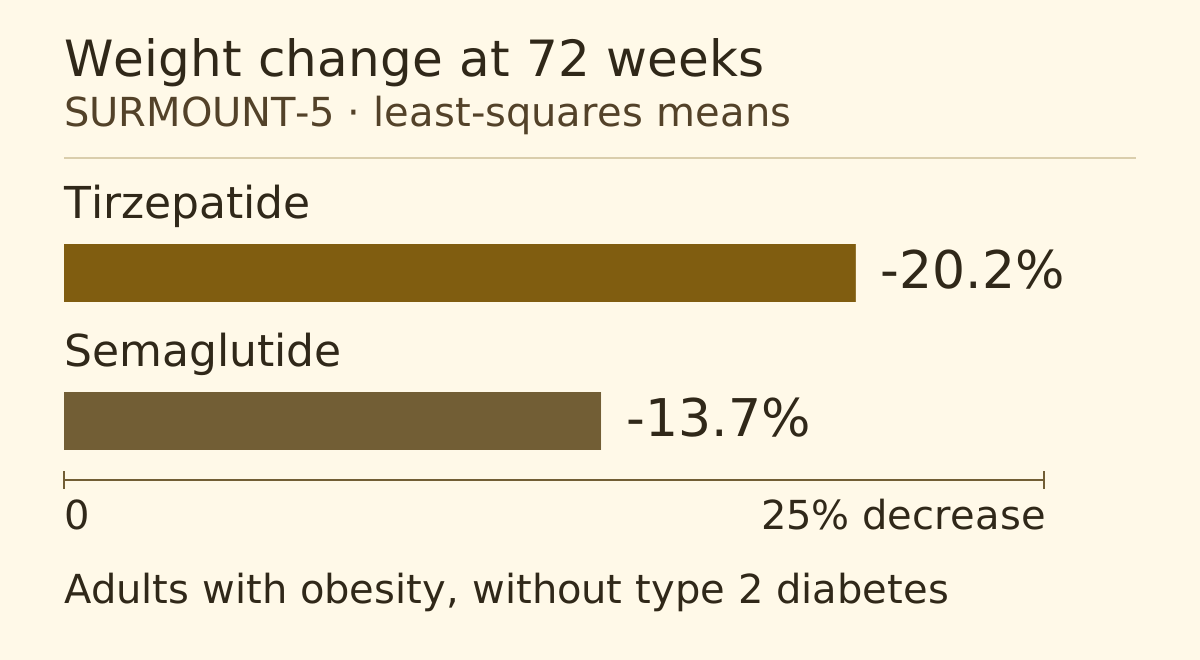
In a 72-week head-to-head trial against semaglutide — the prior single-receptor standard — tirzepatide produced significantly greater weight loss: -20.2% versus -13.7% [11]. In its own pivotal obesity trial, the highest dose produced -20.9% weight loss at 72 weeks versus -3.1% with placebo [14]. In type 2 diabetes, it out-performed semaglutide 1 mg on both blood-sugar control and weight [15].
This page summarizes the published evidence, its regulatory standing, and its cited safety cautions. It recommends no dose and no course of action for any individual; tirzepatide is available only by prescription.
What it is
Tirzepatide is a linear 39-amino-acid synthetic peptide built on a GIP sequence backbone. A C20 fatty diacid (eicosanedioic acid) group is attached, via a glutamic-acid linker and two short polyethylene-glycol spacer units, to a lysine side chain. That fatty-acid arm drives strong, reversible binding to albumin in the blood, which shields the peptide from rapid clearance and extends its half-life to roughly five days — the structural basis for once-weekly dosing. Its molecular formula is C225H348N48O68.
Tirzepatide is often described as a 'twincretin' because it engages both the GIP receptor (GIPR) and the GLP-1 receptor (GLP-1R), but that engagement is not symmetrical. In vitro receptor-occupancy work shows it is an imbalanced dual agonist: it engages GIPR more strongly than GLP-1R, and its GLP-1R signaling is biased — favoring cAMP generation over beta-arrestin recruitment, a signaling pattern proposed to enhance insulin secretion relative to a conventional GLP-1 agonist [16].
How it works
By engaging both receptors, tirzepatide potentiates glucose-dependent insulin secretion from pancreatic beta cells, suppresses inappropriate glucagon release from alpha cells, and slows gastric emptying — the core GLP-1 pharmacology that also underlies appetite suppression and the drug's characteristic gastrointestinal side effects. The GIP receptor arm adds to this incrementally: GIP signaling in adipose tissue and the central nervous system may contribute to tirzepatide's larger weight effect relative to selective GLP-1 agonism, though the precise mechanism is still an active research question [17].
The central appetite-suppression effect runs largely through hypothalamic and brainstem circuits — the same GLP-1-receptor-bearing neurons implicated across this drug class — and produces what patients in exit interviews describe as a quieting of persistent, intrusive food-related thoughts. In discovery work, the combination of both receptor arms produced greater reductions in body weight and food intake in mice than a selective GLP-1 agonist alone, and an initial Phase 1 program in 142 human subjects confirmed pharmacokinetics supporting once-weekly dosing along with reduced fasting glucose and body weight versus placebo [17].
What the research shows
Head-to-head against semaglutide (SURMOUNT-5, 2025). A phase 3b open-label trial in 751 adults with obesity but no type 2 diabetes randomized participants to the maximum tolerated dose of tirzepatide (10 or 15 mg) or semaglutide (1.7 or 2.4 mg) once weekly for 72 weeks. Mean weight change was -20.2% with tirzepatide versus -13.7% with semaglutide (P<0.001); tirzepatide also produced a greater reduction in waist circumference and a higher proportion of participants reaching ≥10%, ≥15%, ≥20%, and ≥25% weight loss [11].
Clinical-reference summary. An NCBI Bookshelf clinical-reference chapter confirms tirzepatide's status as an FDA-approved dual GLP-1/GIP agonist, approved in May 2022 for type 2 diabetes, and notes that weight-loss efficacy was, at that point, an off-label observation ahead of the later dedicated obesity approval [12].
Pancreatitis and gallbladder safety (2023). A systematic review and meta-analysis of nine randomized controlled trials (9,871 participants) found tirzepatide was not associated with a statistically significant increase in pancreatitis versus controls (relative risk 1.46, 95% CI 0.59-3.61), but was associated with a significantly increased risk of the composite outcome of gallbladder or biliary disease (relative risk 1.97, 95% CI 1.14-3.42) [13].
Pivotal obesity trial, SURMOUNT-1 (2022). In 2,539 adults with obesity and no diabetes, once-weekly tirzepatide produced mean weight changes of -15.0% (5 mg), -19.5% (10 mg), and -20.9% (15 mg) at 72 weeks, versus -3.1% with placebo. Adverse events were predominantly gastrointestinal, mild to moderate, and concentrated during dose escalation [14].
Type 2 diabetes versus semaglutide, SURPASS-2 (2021). In 1,879 adults with type 2 diabetes, tirzepatide (5/10/15 mg) reduced HbA1c by an estimated 2.01/2.24/2.30 percentage points, versus 1.86 points for semaglutide 1 mg, over 40 weeks — noninferior and statistically superior at every dose — with correspondingly greater weight reductions [15].
Mechanistic basis for efficacy (2020). In vitro receptor assays established tirzepatide as a GIPR-favoring, biased GLP-1R agonist, and primary-islet experiments showed that beta-arrestin1 limited the insulin response to native GLP-1 but not to GIP or to tirzepatide — a proposed mechanistic explanation for its efficacy advantage over selective GLP-1 agonism [16].
Discovery and Phase 1 proof of concept (2018). The original discovery paper for tirzepatide (then LY3298176) reported that dual GIP/GLP-1 agonism reduced body weight and food intake in mice significantly more than a selective GLP-1 agonist, and a Phase 1 program in 142 human subjects confirmed pharmacokinetics supporting once-weekly dosing along with reduced fasting glucose and body weight versus placebo [17].
Reported effects, cautions & safety
People using tirzepatide in clinical exit interviews and research-community discussion report a strong and fairly consistent cluster of effects. These are anecdotal, not clinical evidence — compiled from published exit-interview studies, post-marketing pharmacovigilance data, and online patient-community accounts, and labeled as such throughout.
Reported benefits (anecdotal, not clinical evidence): the most consistently described benefit is a quieting of persistent food-related thoughts — 'food noise' — with 79-91% of exit-interview participants across SURMOUNT sub-studies listing reduced appetite as a top outcome. Increased energy and reduced afternoon fatigue as weight declines are described by roughly 62-79% of participants across interview studies. Improved mood, self-confidence, better sleep and reduced sleep-apnea symptoms, less joint pain with easier movement, and self-reported improvements in glucose and cholesterol readings are also widely and consistently described in community accounts.
Reported adverse effects (anecdotal, not clinical evidence): nausea is the dominant complaint, described by roughly a quarter to half of community reporters, typically peaking in the first one to two weeks after a dose increase and easing thereafter. An alternating pattern of constipation and diarrhea, tied to slowed gastric emptying, is frequently described, along with occasional sulfur-smelling burps. Injection-site reactions — redness, tenderness, occasional bruising — are the second most-reported category in post-marketing safety data. A subset of users describe metallic taste changes or sudden aversions to previously enjoyed foods, weight-loss plateaus lasting several weeks (widely discussed as a normal part of the process rather than failure), muscle-loss concerns among those who train, and hair thinning appearing three to six months into treatment.
Cited cautions from the clinical literature:
- Gastrointestinal intolerance during dose escalation is the most common adverse-event category in the pivotal trials — mostly mild to moderate, concentrated during the stepwise dose increase, and the leading cause of discontinuation [14].
- Thyroid C-cell tumors / MEN-2 (boxed warning): the prescribing information carries a boxed warning based on rodent data showing dose- and duration-dependent thyroid C-cell tumors with this drug class; a personal or family history of medullary thyroid carcinoma or Multiple Endocrine Neoplasia type 2 is a contraindication. Whether the rodent signal translates to humans is not established [12].
- Pancreatitis is monitored as a class concern, but the dedicated meta-analysis of nine randomized trials found no statistically significant increase versus controls [13].
- Gallbladder and biliary disease is a more consistent signal: the same meta-analysis found a significantly increased risk of the composite outcome, plausibly related to the rate of weight loss itself, a known precipitant of gallstones [13].
- Hypoglycemia when combined with insulin or sulfonylureas: used alone, tirzepatide's glucose-dependent insulin secretion limits hypoglycemia risk, but the risk rises when it is combined with a sulfonylurea or insulin, and dose adjustment of the other agent may be warranted [12].
- Delayed gastric emptying: the same mechanism that slows gastric emptying and contributes to satiety has also raised a periprocedural consideration — retained gastric contents observed at endoscopy in some patients — that anesthesia and endoscopy teams increasingly account for around procedures [14].
- A portion of weight lost is lean mass, not fat — a pattern documented across incretin-class weight-loss therapies generally, prompting researchers to note the value of resistance exercise and adequate protein intake alongside treatment.
- Weight tends to return after stopping — trial-extension data across this drug class show that the metabolic and appetite effects depend on continued use, framing tirzepatide as a chronic rather than a short-course therapy.
- Reduced oral-contraceptive reliability: because tirzepatide slows gastric emptying, the FDA label notes reduced absorption — and therefore reduced reliability — of oral hormonal contraceptives, particularly around the first dose and around each dose increase [12].
Where it fits in appetite, satiety, and metabolic-signaling research
Tirzepatide is the clinical center of gravity on this desk — the compound with the largest trial program, the broadest approved-indication footprint, and the only one of the three to have been tested directly against a prior standard of care and shown to outperform it [11]. Where MOTS-c represents metabolic signaling at its most fundamental and least clinically proven layer, and tesamorelin represents a narrowly approved hormone-axis therapy, tirzepatide represents incretin-receptor pharmacology at its most clinically mature — the compound this desk leads with because it has, by a wide margin, the most evidence to actually read. See the comparison page for how all three stack up side by side.